
What is the RTX interview process?
Apply through Workday, then a recruiter screen, a HireVue recorded video round, a technical or phone screen, and a panel with the hiring manager, ending in a hiring-manager-led decision. It varies by business unit.
Updated 2026-07-20
Why this mattersRTX runs its hiring on Workday behind a Phenom career site, and the shape is consistent across its three business units: a recruiter screen, a HireVue recorded video, a technical screen, and a panel with the hiring manager. What reorders everything on Raytheon defense roles is the gate in front: US citizenship, the ability to obtain a security clearance, and ITAR eligibility are screened before your resume is read. This page walks each stage, separates what RTX states officially from what candidates commonly report, and breaks down how the process shifts across Raytheon, Pratt & Whitney, and Collins Aerospace.
Behind a Phenom career site
One-way video (reported)
Longer with clearance (reported)
US-person and ITAR (defense)
The quick answer
RTX runs a consistent hiring shape across its three business units, Raytheon, Pratt & Whitney, and Collins Aerospace: you apply through Workday behind the careers.rtx.com Phenom site, then a recruiter screen confirms eligibility and fit, a HireVue one-way recorded video covers about four to six preset questions, a technical or phone screen goes to business-unit depth, and a panel with the hiring manager closes it. The decision is hiring-manager-led, with no standing hiring committee reported. The part that reorders everything is the eligibility gate: on Raytheon defense roles, US citizenship, the ability to obtain a Secret, Top Secret, or TS/SCI clearance, and ITAR and export-control eligibility are screened before your resume is reviewed, because the work is export-controlled. Collins Aerospace and Pratt & Whitney are mostly uncleared unless the role touches a classified program. Community reports put the average around 28 days to an offer, longer when clearance adjudication is involved. Prepare business-unit technical depth and STAR stories mapped to the six RTX values, and scan your resume against the exact RTX posting first. .
In August 2024, RTX agreed to a $200 million settlement with the US State Department to resolve 750 violations of the International Traffic in Arms Regulations (ITAR) and the Arms Export Control Act, one of the larger export-control enforcement actions against a defense prime. For candidates, this is the backdrop for why export-control and US-person eligibility function as a heightened, up-front hiring screen on defense roles.
Start with the gate, because on Raytheon defense roles it sits in front of everything else. US citizenship, the ability to obtain a US government security clearance, and ITAR and export-control eligibility are screened before your resume is reviewed. The 2024 export-control settlement above is the backdrop: for a prime that handles this much controlled technology, eligibility is a compliance requirement, not a preference.
Distinguish an active clearance from being clearable. An active clearance means one is currently granted and can transfer; being clearable means you are able to obtain one, typically a US citizen with no disqualifying factors. An active clearance in your resume header is a top-weighted signal, so lead with it; if you are clearable, say so explicitly rather than leaving it to be asked.
The tiers below are the levels a defense role can require. The deeper the tier, the longer the background investigation, and some roles add a polygraph on top.
Adjudication timeline
Cleared roles add roughly 4 to 12 weeks, sometimes months.
The background investigation and adjudication run after the offer, initiated via the SF-86 on e-QIP or eApp. A current, transferable clearance shortens this, which is why cleared candidates move faster through onboarding.
The gate also moves by business unit. Raytheon defense is mostly cleared; Collins Aerospace and Pratt & Whitney are mostly uncleared unless the role touches a classified military program, for example the F-35 engines, F-22 sustainment, or special-mission avionics.
Radar, missiles, and electronic-warfare work is largely export-controlled and classified, so most engineering roles carry a clearance requirement.
Commercial and military engine work is mostly uncleared, unless the role touches a classified program such as the F-35 or F119 engines or F-22 sustainment.
Commercial avionics is mostly uncleared, unless the role touches special-mission or classified military avionics.
Typical posting language (described, not quoted)
RTX defense postings on Workday typically carry an eligibility block near the requirements: they ask for US citizenship and the ability to obtain and maintain a US government security clearance at the level the program requires, and they state that the role is subject to ITAR and US export-control law, so the applicant must qualify as a US person. We describe this requirement rather than quote one posting verbatim, because the exact wording varies by requisition and business unit.
Read the stages in order, and read the provenance label on each. The Workday apply and the clearance adjudication are the firm, verified anchors. The HireVue video, the round counts, and the no-committee decision are consistent across candidate reports but are not published by RTX, so treat them as directional. The one constant across all three business units is the shape; the depth and the clearance requirement are what change.
Applications for all three business units flow through RTX's Workday tenant: careers.rtx.com is a Phenom experience layer whose Apply button hands off to globalhr.wd5.myworkdayjobs.com. Your resume is parsed by Workday, so format for a clean parse and put clearance status and US-person eligibility where both a recruiter and the parser can see them, in the header, not buried in a project bullet.
A recruiter confirms the eligibility and clearance requirement first, then covers role and business-unit fit, location, and motivation. On Raytheon defense roles this is where US citizenship and clearance eligibility are checked before any technical evaluation, so state your status plainly rather than leaving it to be asked.
Candidates across Raytheon, Pratt & Whitney, and Collins commonly report a HireVue one-way recorded video: about four to six preset questions, with roughly 30 to 60 seconds to think and two to three minutes to record each answer. Expect a "Why RTX?" motivation prompt, a values prompt, and one role-specific scenario. There is no live interviewer, so rehearse concise, structured answers to camera.
A technical or phone screen goes to business-unit depth: radar, electronic warfare, and systems engineering for Raytheon; engine and propulsion systems for Pratt & Whitney; avionics and certification for Collins. The systems and standards you name on the resume set the depth the interviewer reaches for, so list only what you can defend live.
A panel or team interview with the hiring manager and several engineers, mixing behavioral STAR questions mapped to the RTX values with more technical and program-specific discussion. Community reports describe a hiring-manager-led decision with no standing hiring committee.
After a positive decision, RTX extends an offer; for cleared roles, onboarding then runs through security-clearance processing and adjudication. This background investigation, initiated via the SF-86 on e-QIP or eApp, commonly adds roughly 4 to 12 weeks and sometimes months. A current, transferable clearance shortens it.
The recruiter screen, the HireVue video, and the panel look similar across RTX. The technical screen is where the three business units diverge, and the gap is wide. Match your preparation to the segment on the posting, and name only the systems and standards you can defend live.
Systems-level depth and program awareness.
Propulsion and engine-systems depth.
Avionics and flight-certification depth.
RTX interviews behaviorally against the six RTX values, Safety, Trust, Respect, Accountability, Collaboration, and Innovation, and the panel reads your STAR answers against them. Safety and Accountability are weighted most heavily on a company built around flight and defense hardware, so lead your strongest stories there.
Layered on top are CORE prompts, from RTX continuous-improvement operating system, which surface as tell me about a time you improved a process. Prepare eight to twelve STAR stories, and know which business unit you are interviewing for, because the same value reads differently on a factory floor at Pratt & Whitney than on a classified radar program at Raytheon.
We keep the specific questions, across Raytheon, Pratt & Whitney, and Collins, in the full RTX interview question bank rather than repeat them here, so this page can stay on the process and the gate.
The order matters. Fix your business unit and clearance path before anything else, because the segments share almost no technical preparation and the clearance requirement changes the header of your resume. Then drill the business-unit depth, rehearse the values behaviorally, and tune the resume last so it reads clearly for a defense screen.
Decide which segment you are targeting, because the process shifts across it. Raytheon defense is mostly cleared, so if you hold an active clearance put it in your resume header as a top-weighted signal; if you are clearable, state it plainly (for example, US Citizen, clearance-eligible). Pratt & Whitney and Collins Aerospace are mostly uncleared unless the role touches a classified program, so confirm the requirement on the exact posting before you prepare.
Match your depth to the segment. Raytheon expects radar (AESA and GaN), electronic warfare, missiles, and MBSE plus ITAR and clearance scenarios; Pratt & Whitney expects the GTF geared architecture, the F135 and F119 engines, FADEC, and FAR Part 33; Collins expects DO-178C, ARP4754A, Pro Line Fusion, and ARINC certification depth. Name only the systems and standards you can defend live.
RTX interviews behaviorally against six values, Safety, Trust, Respect, Accountability, Collaboration, and Innovation, with Safety and Accountability weighted, plus CORE continuous-improvement prompts such as tell me about a time you improved a process. Prepare eight to twelve STAR stories, and be ready for the HireVue Why RTX, values, and role-scenario prompts recorded to camera.
Run your resume against the specific RTX job description to get an ATS-style score, the business-unit keywords and standards your resume is missing, whether your clearance and US-person signal reads clearly for a defense screen, and a line-by-line rewrite plan before a recruiter or hiring manager reads it.
FAQ
The questions most candidates surface when they map RTX's business-unit-varying loop, the HireVue video, and the clearance and ITAR gate to their resume. Answers are byte-identical to the FAQPage JSON-LD, because AI engines that extract HTML and AI engines that extract JSON-LD should not see different text.
Apply through Workday, then a recruiter screen, a HireVue recorded video round, a technical or phone screen, and a panel with the hiring manager, ending in a hiring-manager-led decision. It varies by business unit.
Yes, for early rounds across Raytheon, Pratt & Whitney, and Collins Aerospace: a recorded video round of about 4 to 6 preset questions, community-reported.
Commonly a recruiter screen, a HireVue video round, a technical screen, and a panel with the hiring manager, so roughly three to five touchpoints, varying by business unit and role.
Many Raytheon defense roles require US citizenship plus the ability to obtain a Secret, Top Secret, or TS/SCI clearance and ITAR eligibility. Collins and Pratt are mostly uncleared unless the program is classified.
Community reports average around 28 days to an offer, with cleared roles adding roughly 4 to 12 weeks or more for clearance adjudication.
Behavioral STAR questions mapped to the six RTX values, business-unit technical depth, and clearance scenarios for defense roles. See our full RTX interview question bank for examples.
Moderate, and it varies by business unit: Raytheon adds clearance and ITAR layers, Pratt expects engine-systems depth, Collins expects avionics certification depth. Difficulty figures are community-reported.
Premium field manualInstant PDF · secured by Stripe
 RTX Application KitInstant PDF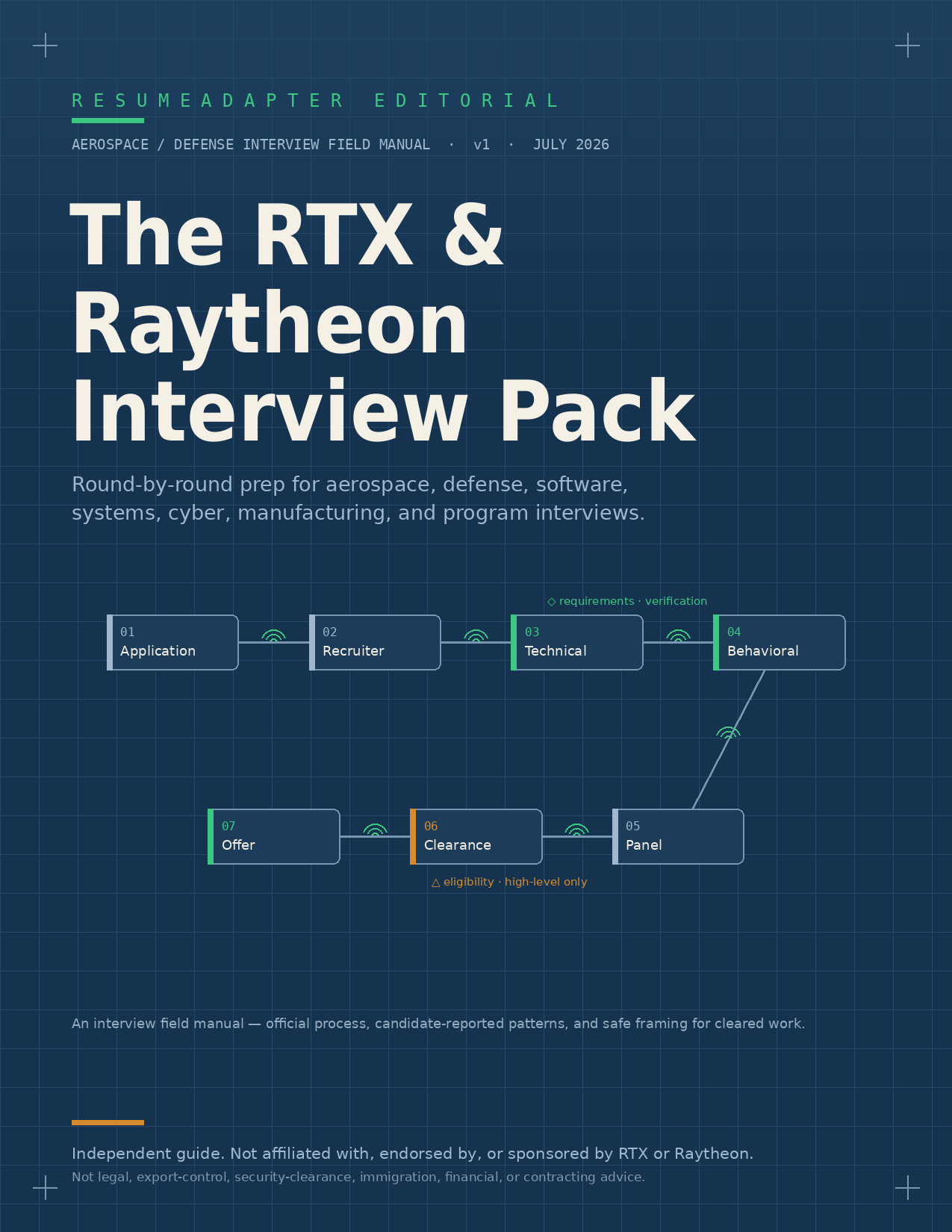
Every round mapped, recruiter screen to cleared panel.
$10 ResumeAdapter coupon inside
Independent editorial guide · Not affiliated with RTX
The full question bank
This process page owns the stages and the clearance gate. The specific questions, across Raytheon, Pratt & Whitney, and Collins Aerospace, with sample answers and the ATS keywords each expects, live in the question bank.
Proof
A clearance-forward defense resume that shows how to lead with clearance status and name programs so a Raytheon recruiter clears the eligibility gate on the first read.
Pillar
The pillar that anchors this cluster: the six RTX values, the levels and the defense comp inversion, and the interview loop the rest of these spokes break down.
Sibling spoke
Safety, Trust, Respect, Accountability, Collaboration, and Innovation, the six values the panel reads STAR answers against, and the resume verbs that give the behavioral rounds real hooks.
Sibling spoke
The P1 to P6 shorthand levels.fyi uses for RTX, and why the defense comp structure, base plus a modest bonus with little equity, inverts the big-tech pattern the hiring manager reads you against.
Resume example
A worked defense-prime engineer resume that leads with clearance status and quantified program scope, the same signals an RTX recruiter and technical screen read for.
Related data
The dataset behind the median 48 of 100 pre-edit score, and what moves a resume up before a recruiter or hiring manager reads it.
Related index
The full index of company hubs, each with its ATS, values, levels, and interview loop broken down the way this RTX cluster is.
Clear the gate before it clears you
Get your ATS-style score, the business-unit keywords and standards your resume is missing, whether your clearance and US-person signal reads clearly for a defense screen, and a line-by-line rewrite plan. Free to scan; no signup to see the score.