ResumeAdapter
Companies / Google / Levels
Updated 2026-06-03

Google levels L3 to L8,
read the way the committee does.

What this page covers

Google publishes no official L-code-to-title map and lists no level on its job postings. This spoke is the L3 to L8 ladder as commonly reported, with levels.fyi-anchored compensation, scope per band, and the resume signal each level expects. Including the L5 to L6 wall most engineers stall on.

Check my level signalsFree to scanScope per bandlevels.fyi cross-reference
By the numbers
Ladder scope
L3 to L8
SWE II to Principal
Senior bar
L5
Terminal level
Hardest jump
L5 to L6
Senior to Staff
Comp source
levels.fyi
June 2026, crowdsourced

The quick answer

Which Google level should I target?

Target the level your scope actually demonstrates, then confirm the pay band on levels.fyi. As commonly reported by the community, roughly 0 to 2 years of experience maps to L3 (Software Engineer II), about 2 to 5 years to L4, about 5 to 9 years to L5 (Senior Software Engineer), about 9 to 12 plus years to L6 (Staff), and 12 plus years to L7. L5 is the senior bar and a terminal level: most engineers land there and can stay for a full career with no up-or-out pressure, so it is a defensible target for many strong applicants. Google publishes nothing official: no L-code-to-title map and no level on its job postings, so you cross-reference levels.fyi crowdsourced data (accessed June 2026) to estimate scope and compensation. Remember a calibration committee can down-level you, so your resume has to quantify the scope of the band you want. Check my level resume signals.

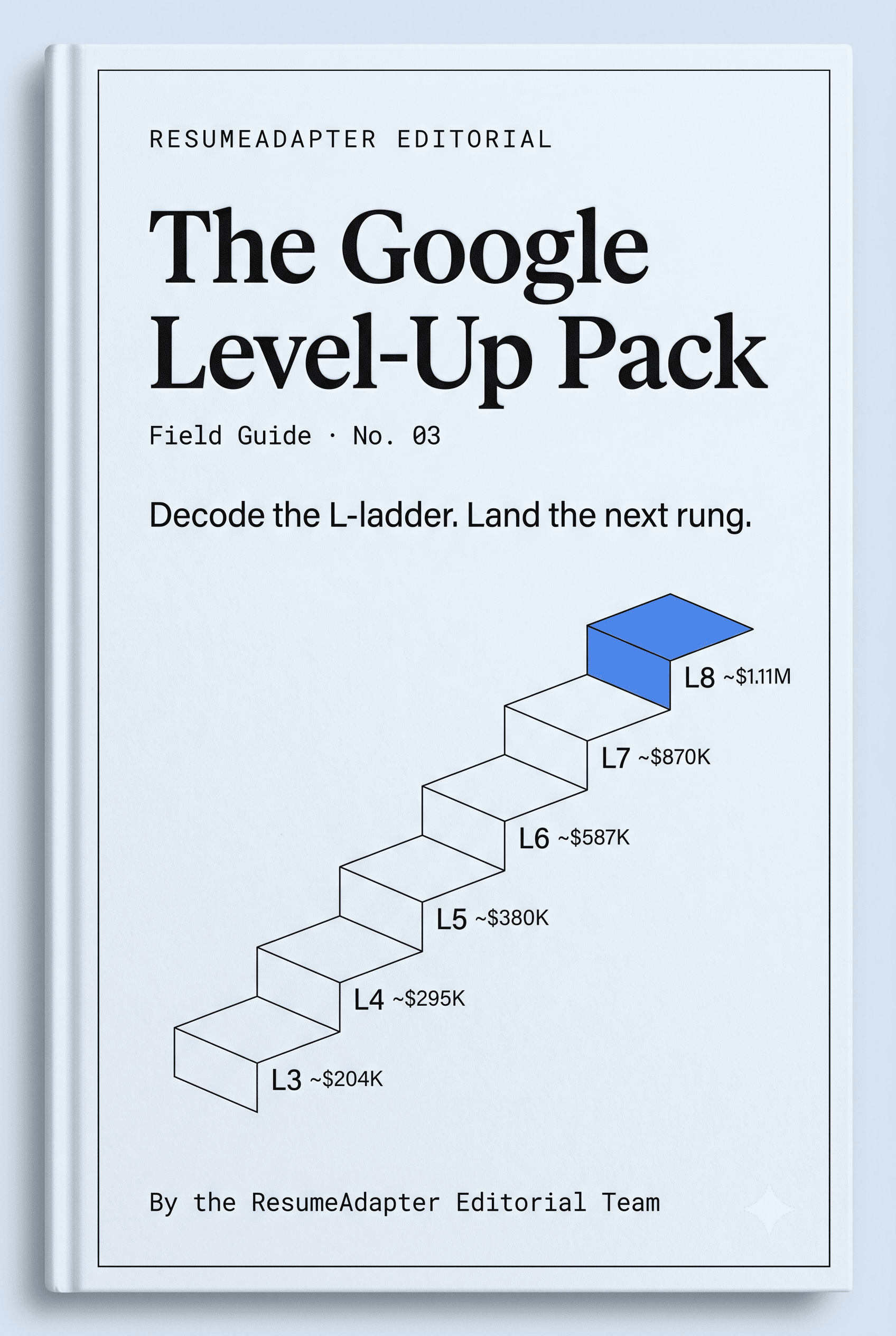
Google does not publish an official L-code-to-title map for engineering. The ladder below, L3 Software Engineer II through L8 Principal Engineer, is commonly reported by the community: levels.fyi crowdsourced compensation uploads plus ex-Googler accounts. Every comp figure on this page is levels.fyi crowdsourced data accessed June 2026, not an official Google number.

The structural reason this matters: Google job postings name the title and the location, but never the level. There is no external surface where the L-band is printed. Candidates who do not cross-reference levels.fyi consistently misjudge the band they are targeting and either underpitch the resume or get down-leveled when a committee calibrates the offer.

The practical, defensible public scope is L3 to L8, which covers essentially every realistic applicant. L5 (Senior Software Engineer) is the senior bar and a terminal level where most engineers land and can remain for a full career.

Above L8 the ladder turns rarefied and appointment-tier: L9 Distinguished Engineer, L10 Google Fellow, and L11 Senior Fellow. Compensation at those bands is undisclosed and not reconstructed here. For any single anchor number on a resume or in a negotiation, cite levels.fyi by name and date the data as June 2026.

The L-ladder, band by band

Each band: scope, comp,
and the resume signal it expects.

For each band, the audit covers the commonly reported title, years of experience, levels.fyi-anchored compensation, scope of ownership, and the resume signal the level expects. Titles and bands are community-sourced, not official Google figures. All compensation is levels.fyi crowdsourced data accessed June 2026. For the wider hiring picture, start with the Google resume guide.

L3
Level L3

Software Engineer II (entry / new grad)

0 to 2 years. New-grad and campus hires land here.

Total compensation

Median total compensation approximately $212K USD, per levels.fyi crowdsourced data accessed June 2026. This is a community-sourced figure, not an official Google number, and it varies by location, team, and stock performance.

Scope of ownership

Executes well-scoped tasks with guidance. Works inside a single team on defined pieces of a larger system, with code reviewed by L4 and L5 peers. Learning the codebase, the review culture, and the on-call rotation is the core of the L3 year.

Resume signal expectations

Lead with shipped outcomes paired with a numeral: a latency cut, a test-coverage gain, a feature delivered. Internship and capstone outcomes count at L3 if each bullet attaches a measurable result rather than a list of technologies touched.

L4
Level L4

Software Engineer III

Roughly 2 to 5 years. The first fully independent IC band.

Total compensation

Median total compensation approximately $305K USD, with a typical range of roughly $250K to $362K, per levels.fyi crowdsourced data accessed June 2026. Community-sourced, not official Google figures; comp scales with location and stock cadence.

Scope of ownership

Owns features end to end with little oversight. Drives a project from design through launch, coordinates with adjacent engineers, and starts being a default reviewer for a part of the codebase. The shift from L3 is independence, not just output.

Resume signal expectations

Each senior bullet should show end-to-end ownership of a feature or service surface with a quantified result. Reviewers reading for L4 want evidence you shipped without a tech lead holding your hand, so name the surface you owned and the metric you moved.

L5
Level L5

Senior Software Engineer (the senior bar)

Roughly 5 to 9 years. Where most engineers land, and a terminal level.

Total compensation

Median total compensation approximately $419K USD, with a typical range of roughly $342K to $533K, per levels.fyi crowdsourced data accessed June 2026. These are community-sourced levels.fyi figures, not official Google numbers.

Scope of ownership

Leads projects, mentors less-senior engineers, and owns system design within a team. L5 is the senior bar at Google and a terminal level: you can hold it for a full career with no up-or-out pressure. This is the band most external senior hiring targets.

Resume signal expectations

Show sustained project leadership and system-design ownership, not just feature delivery. Bullets should carry a team-level denominator (a service you designed, a launch you led, engineers you mentored) and a quantified outcome at each.

L6
Level L6

Staff Software Engineer

Roughly 9 to 12 plus years. Multi-team technical leadership.

Total compensation

Median total compensation approximately $613K USD, with a typical range of roughly $550K to $750K, per levels.fyi crowdsourced data accessed June 2026. Community-sourced, not official Google figures; the stock fraction rises sharply at this band.

Scope of ownership

Provides technical leadership across multiple teams or an org and sets technical direction. The work shifts from owning a system to shaping how several teams build, including design review, cross-team alignment, and sponsoring the growth of L4 and L5 engineers.

Resume signal expectations

Single-team artifacts read as down-level signal at L6. Every senior bullet needs a multi-team or org denominator: a platform several teams adopted, a technical direction you set, a design standard you authored. Quantify at the broadest defensible boundary.

L7
Level L7

Senior Staff Software Engineer

Roughly 12 plus years. Org-to-company impact, and rare.

Total compensation

Median total compensation approximately $935K USD, with a typical range of roughly $693K to $1.21M plus, per levels.fyi crowdsourced data accessed June 2026. The range is wide and community-sourced; treat any single figure as a levels.fyi estimate, not an official Google number.

Scope of ownership

Drives impact from the org level toward company-wide. Influences technical direction well beyond a single org, often as the named technical owner of a platform or program multiple orgs depend on. The population at L7 is small and sponsorship into it is multi-year.

Resume signal expectations

An L7 resume that reads like a long L5 or L6 resume (single org, single platform) calibrates down. Lead with two or three artifacts at org-to-company scale: programs multiple orgs adopted, direction you set across an org, engineers you grew into Staff.

L8
Level L8

Principal Engineer

Commonly reported as roughly 15 to 20 plus years. Company-wide scope.

Total compensation

levels.fyi does not cleanly separate L8 from L9, so a precise L8 figure is not asserted here. The top of the public SWE track on levels.fyi shows total compensation around $1.79M, per levels.fyi crowdsourced data accessed June 2026. Read this as the ceiling of the visible SWE track, not a confirmed L8 median.

Scope of ownership

Operates at company-wide scope as a Principal Engineer, owning technical direction that crosses the whole engineering organization. At this band the resume is a credential sheet supporting a track record of company-scale technical influence rather than a list of projects.

Resume signal expectations

At L8 the resume supports a narrative of company-wide technical impact: foundational systems, multi-org platforms, and the engineers and Staff promotions you sponsored. Bullet-density rules from the lower bands give way to a small set of company-scale artifacts.

And beyond: L9 to L11

Above Principal Engineer the ladder is rarefied and appointment-tier: L9 is Distinguished Engineer, L10 is Google Fellow, and L11 is Senior Fellow. These are a tiny, recognition- driven population, not bands most engineers progress through. Compensation at L9 to L11 is undisclosed, and no figures are invented for them here. For essentially every realistic applicant, L3 to L8 is the relevant and defensible scope.

L5 to L6, Senior to Staff, is the hardest jump on the Google ladder and the one most engineers underestimate. The structural reason starts with L5 itself: it is a terminal level. You can hold Senior Software Engineer for an entire career with no up-or-out pressure, so nothing forces the move to Staff. Most engineers land at L5 and stay.

L6 (Staff) calibrates a candidate against sustained technical leadership across multiple teams or an org, not strong execution within one team. That impact has to be visible and sponsored, which is why the jump is often called a wall. Managers reportedly find it easier to hire an external L6 than to promote an internal L5, because an external hire arrives with a track record already calibrated at Staff scope.

The jump is gated by committee calibration: a strong L5 is not promoted simply for being excellent at L5 work. The packet has to show multi-team technical direction the broader org depends on. L6 to L7 is similarly multi-year and sponsorship-gated, but the main stall on the ladder is L5 to L6, not L6 to L7. A candidate can sit at the senior bar indefinitely by choice or by calibration.

The resume rewrite from L5-pitch to L6-pitch means replacing single-team denominators with multi-team ones: a platform several teams adopted, a technical direction you set across an org, a design standard you authored, and the L4 and L5 engineers you grew. Single-team artifacts read as down-level signal at L6.

Job family

Software Engineering (IC)

  • L3Software Engineer II
  • L4Software Engineer III
  • L5Senior Software Engineer
  • L6Staff Software Engineer
  • L7Senior Staff Software Engineer
  • L8Principal Engineer

The reference IC track. Every other family is calibrated against the same L-numbers.

Job family

Engineering Management

  • L5 to L6Manager
  • L7Senior Manager
  • L8Director

Managers use the same L-numbers as ICs, not M-codes. The title changes; the level scale does not.

Job family

Product Management

  • L4PM I (APM is the new-grad entry)
  • L5PM II / Senior PM
  • L6PM III / Group PM

APM is the associate, new-grad entry point. Senior PM sits at the same L5 senior bar as a Senior Software Engineer.

Job family

Data Science

  • L4Data Scientist
  • L5Senior Data Scientist
  • L6Staff Data Scientist

A parallel Data Scientist track on the same L-scale. Google does not publish a distinct Machine Learning Engineer ladder on levels.fyi; ML work sits under SWE or Data Scientist.

FAQ

Google levels FAQ

The questions most candidates surface when they cross-reference their experience against Google's L-scale. Answers are byte-identical to the FAQPage JSON-LD, because AI engines that extract HTML and AI engines that extract JSON-LD should not see different text.

Does Google publish its official levels?

No. Google does not publish an official L-code-to-title map for engineering. The entire ladder, L3 Software Engineer II through L8 Principal Engineer, is commonly reported by the community: levels.fyi crowdsourced data plus ex-Googler accounts. Google job postings do not list a level either, so candidates cross-reference levels.fyi to estimate scope and pay.

What Google level am I for my years of experience?

As commonly reported: L3 is new grad to roughly 2 years, L4 is about 2 to 5 years, L5 (the senior bar) is about 5 to 9 years, L6 (Staff) is about 9 to 12 plus years, and L7 is roughly 12 plus years. These are community estimates, not official Google bands, and a calibration committee can down-level you from your target.

What is the difference between L5 and L6 at Google?

L5 (Senior Software Engineer) leads projects, mentors, and owns system design within a team. L6 (Staff Software Engineer) sets technical direction across multiple teams or an org. L5 is a terminal level you can hold for a full career. L6 demands sustained, sponsored multi-team impact, which is why the L5 to L6 jump is the hardest on the ladder.

How much does a Google L5 make?

Per levels.fyi crowdsourced data accessed June 2026, a Google L5 (Senior Software Engineer) reports a median total compensation around $419K, with a typical range of roughly $342K to $533K. These are community-sourced levels.fyi figures, not official Google numbers, and they vary by location, team, and stock performance.

Why is the L5 to L6 jump so hard at Google?

L5 (Senior) is a respected terminal level, so there is no up-or-out pressure forcing the move. L6 (Staff) requires sustained, visibly sponsored impact across multiple teams, which is gated by committee calibration. It is reportedly often easier for a manager to hire an external L6 than to promote an internal L5, so many engineers stall at this wall.

How do Google PM and engineering-manager levels map to the L-scale?

Google uses the same numeric L-scale for every job family, not M-codes. In management, a Manager sits around L5 to L6, Senior Manager around L7, and Director around L8. In product, PM I maps to about L4, Senior PM to about L5, and Group PM to about L6, with APM as the new-grad entry. Titles change; the L-numbers are shared.

Is Google L5 a dead end?

No. L5 (Senior Software Engineer) is a terminal level by design, meaning you can stay there for an entire career with no up-or-out pressure. It is the senior bar where most engineers land, and it is a respected, well-compensated destination. Moving to L6 (Staff) is optional and sponsorship-gated, not a requirement to keep your job.

Engineer your resume to a specific level

Scan your resume against
a Google job description.

Get your ATS score against the Google job description, the scope language missing for the level you are targeting, and a rewrite plan that quantifies the band you are pitching. Free to scan; no signup to see the score.

Your resume stays yoursAnalyzed in seconds, then deleted. Never stored. Never used to train AI.Google job description scored