ResumeAdapter
Updated 2026-06-03

Googleyness is not a buzzword.
It is one of four attributes.

What this page covers

Google scores candidates on four attributes: General Cognitive Ability, Role-Related Knowledge, Leadership, and Googleyness. This page goes deep on each one. For every attribute you get what Google actually means by it, what the interviewer and hiring committee probe, a do-this resume bullet with worked example, the anti-pattern to delete, and a sample behavioral question, plus a careful read of the December 2024 Googleyness values reframe.

Scan my Google resumeFree to scanGoogle CareersAttribute coverage report
By the numbers
Hiring attributes
4
GCA, RRK, Leadership, Googleyness
Most weighted
GCA
Problem-solving
Behavioral round
G&L
~45 min, STAR
Culture reframe
Dec 2024
Six values

The quick answer

What is Googleyness, and how do I show it in 2026?

Googleyness is Google's culture-fit hiring signal, one of four attributes alongside General Cognitive Ability, Role-Related Knowledge, and Leadership. As defined by former Google SVP Laszlo Bock in Work Rules!, it means intellectual humility, comfort with ambiguity, conscientiousness, bias to action, collaboration, and user-first thinking. Those original traits are still the interview signal. In December 2024, CEO Sundar Pichai offered a six-point company-values reframe (Mission First, Make Helpful Things, Be Bold & Responsible, Stay Scrappy, Hustle & Have Fun, Team Google), but that is how Google now describes its culture internally, not a documented change to how candidates are interviewed or scored. On a resume, demonstrate Googleyness rather than naming it: navigated undefined requirements to launch X, reprioritized on user feedback, partnered across teams to unblock Y. Avoid lone-hero framing and the literal word Googleyness. Scan your resume for attribute coverage.

Google evaluates candidates against four attributes: General Cognitive Ability, Role-Related Knowledge, Leadership, and Googleyness. The framework is attributed to Laszlo Bock, Google's former SVP of People Operations, in his book Work Rules! (2015), and is corroborated by credible recruiting sources. It is worth being precise: this framework is not published verbatim on a current live Google page. The re:Work page that once defined these attributes now returns a 404, so the framework is documented through Bock and recruiter sources rather than cited to google.com.

Of the four, General Cognitive Ability is widely reported as the most heavily weighted, on the bet that a strong learner can acquire role-specific knowledge over time. Role-Related Knowledge is reported as the least weighted, though Google still verifies it in the interview. Leadership is emergent: influence without formal authority, not people-management. Googleyness is the culture-fit signal and the hero of this page.

The resume reading is the same for all four: a Google recruiter and hiring committee index on the attribute being visible in the bullet itself, not asserted as an adjective. A line that reads a great culture fit who embodies Googleyness fails, because it names the attribute instead of demonstrating it, and the lone-hero tone runs against the intellectual humility the attribute prizes.

A line that reads navigated undefined requirements to launch a self-serve onboarding flow in 7 weeks, reprioritized twice on user feedback, and credited the cross-team group passes, because it shows comfort with ambiguity, bias to action, and collaboration without ever using the word. The four entries below give you that pattern for each attribute, plus the anti-pattern to delete and a sample behavioral question.

The four hiring attributes, deep-dived

Every attribute with what it probes,
a worked bullet, and the question.

Framework attributed to Laszlo Bock, Work Rules! (2015), and credible recruiting sources. It is not published verbatim on a current live Google URL: the re:Work page that defined these attributes now returns a 404, so the framework is documented via Bock and recruiter sources rather than cited to google.com.

01
Hiring attribute 01

General Cognitive Ability (GCA)

Your ability to solve novel, ambiguous problems and to learn, rather than what you already know. Widely reported as the most heavily weighted of the four attributes. Bock framed GCA as how you think, not what you have memorized.

What Google means by it
What the interviewer probes

How you decompose an unfamiliar problem out loud: the structure of your thinking, the assumptions you surface, how you handle a curveball mid-answer. Interviewers and the hiring committee are reading for analytical reasoning and learning agility, not for recall of a known answer. A candidate who jumps straight to a tool without framing the problem reads as low GCA.

Do this on the resume

Lead with a hard or novel problem you solved, show the analytical decomposition, and quantify the outcome. Verb plus numeral, and make the reasoning visible, not just the tool.

Reduced fraud false-positives 34% by decomposing a misclassification problem into three feature-drift hypotheses, isolating the root cause to a stale geolocation signal, and shipping a recalibrated model in 5 weeks.

Avoid this anti-pattern

Tool-listing with no problem and no reasoning. A wall of frameworks and languages signals recall, not cognitive ability. The phrase strong problem-solver with no decomposition and no numeral is the most common GCA anti-pattern.

Strong problem-solver proficient in Python, SQL, TensorFlow, and a wide range of data-science frameworks and methodologies.

Sample behavioral question

Tell me about the most ambiguous problem you have worked on. How did you break it down when you did not yet know the answer?

02
Hiring attribute 02

Role-Related Knowledge (RRK)

The specific domain and technical expertise the role requires: the depth you bring to this job, not a general one. Reported as the least weighted of the four attributes, on the logic that a high-GCA learner can acquire role knowledge, but Google still verifies you can do the actual work.

What Google means by it
What the interviewer probes

Whether your depth matches the job description: the specific systems, languages, domains, and competencies the role names. Interviewers probe for demonstrated competence backed by results, not a keyword list. This is the one attribute where exact-match terminology and depth genuinely belong, because the interviewer is verifying you can do the work on day one.

Do this on the resume

Mirror the job description's required skills with specific demonstrated competencies and the results they produced. Exact-match keywords and depth signals belong here more than anywhere else on the resume.

Designed and operated a distributed feature store serving 2.1B daily lookups at p99 under 40ms, the exact low-latency serving competency named in the job description, cutting model staleness from 6 hours to 12 minutes.

Avoid this anti-pattern

Padding the skills line with terms you cannot defend in an interview, or claiming depth you do not have. RRK without a demonstrated result reads as a keyword stuff, and a Google interviewer will probe one level deeper than the resume claims.

Familiar with distributed systems, machine learning, cloud infrastructure, and a broad spectrum of modern engineering practices and tools.

Sample behavioral question

Walk me through the most technically demanding part of a system you built that maps directly to what this role requires.

03
Hiring attribute 03

Leadership

Emergent leadership: stepping up to lead when a situation calls for it, then ceding control once it no longer does. This is influence without formal authority, not people-management. Bock described it as the willingness to lead at the right moment and to follow at others, regardless of title.

What Google means by it
What the interviewer probes

Whether you have led without being the named owner: drove alignment across teams, stepped into a gap nobody owned, then handed control back. Interviewers are wary of candidates who equate leadership with a manager title or with headcount. The signal is initiative and influence, and crucially the cede-control half, where you let someone else lead once your part was done.

Do this on the resume

Show influence without authority: drove cross-functional alignment among N teams, led X when no owner existed. Name the initiative and the outcome, not the title.

Drove cross-functional alignment among 4 teams to unblock a stalled launch with no assigned owner; coordinated the cutover plan, shipped on the revised date, then handed ongoing ownership to the platform team.

Avoid this anti-pattern

Title-and-headcount bullets that count people managed rather than influence exercised. Managed a team of N says nothing about emergent leadership, and lone-hero framing that never cedes control reads as ego, not the attribute.

Managed a team of 9 and was responsible for delivery, hiring, and day-to-day execution across all major initiatives.

Sample behavioral question

Tell me about a time you took the lead on something that was not your responsibility, and what you did once the situation no longer needed you in charge.

04
Hiring attribute 04

Googleyness

The culture-fit signal, and the hero of this page. In Bock's original definition (Work Rules!, 2015) it covers enjoying fun, intellectual humility (it is hard to learn if you cannot admit you might be wrong), conscientiousness (owners, not employees), comfort with ambiguity, and evidence you have taken courageous or interesting paths. It is also commonly summarized as bias to action, collaboration, and user-first thinking. The interview Googleyness signal is still described using these original traits.

What Google means by it
What the interviewer probes

Whether you bring intellectual humility, comfort with ambiguity, a bias to action, and collaboration, surfaced through how you describe past situations. Interviewers listen for whether you can say I was wrong, how you moved when the requirements were undefined, and whether you credit the team. Ego-heavy, lone-hero answers read as un-Googley. Note: the December 2024 six-point list below is a company-values reframe, not a documented change to how this attribute is interviewed or scored.

Do this on the resume

Surface comfort with ambiguity, bias to action, collaboration, intellectual humility, and user-first thinking through concrete situations: navigated undefined requirements to launch X, reprioritized on user feedback, partnered across teams to unblock Y. Avoid lone-hero and ego framing.

Navigated undefined requirements to launch a self-serve onboarding flow in 7 weeks; reprioritized twice on early user feedback, partnered with support and design to unblock the flow, and credited the cross-team group when adoption rose 28%.

Avoid this anti-pattern

Listing Googleyness, or culture fit, as a buzzword instead of demonstrating it, and ego framing that never admits a wrong call or shares credit. Self-described culture fit with no situation behind it is the most common Googleyness anti-pattern, and naming the attribute on the resume reads as telling rather than showing.

A great culture fit who embodies Googleyness, thrives in ambiguity, and is passionate about collaboration and innovation.

December 2024: the values reframe, read carefully

On December 18, 2024, at an internal strategy meeting, CEO Sundar Pichai said the term Googleyness had become too broad and offered a more focused six-point framing. The six labels below are the exact terms he used; the explanatory clauses are reporters' paraphrases, not Pichai quotes.

Read this as how Google now describes its culture internally, distinct from the interview attribute. It is a company-culture and values reframe, not a documented change to how candidates are interviewed or scored. The interview Googleyness signal is still described using the older traits: intellectual humility, comfort with ambiguity, bias to action, and collaboration. Do not write a resume to score these six points.

  1. 01Mission First

    Reporters paraphrase this as keeping Google's mission, organizing the world's information, ahead of internal politics.

  2. 02Make Helpful Things

    Paraphrased as building products that are genuinely useful to people rather than impressive for their own sake.

  3. 03Be Bold & Responsible

    Paraphrased as taking ambitious swings while owning the consequences and the risk.

  4. 04Stay Scrappy

    Paraphrased as moving with the resourcefulness of a smaller company despite Google's scale.

  5. 05Hustle & Have Fun

    Paraphrased as pairing intensity and pace with the enjoyment Bock's original definition also prized.

  6. 06Team Google

    Paraphrased as operating as one company rather than competing fiefdoms.

Sources: CNBC (Dec 27, 2024), Fortune (Dec 28, 2024), American Bazaar (Dec 26, 2024).

Sample behavioral question

Tell me about a time the requirements were unclear and you had to act anyway. What did you get wrong, and how did you adjust with the team?

Google runs a dedicated behavioral interview commonly called Googleyness & Leadership, or G&L. It is typically one round of about 45 minutes with roughly four to six behavioral questions, usually answered in STAR format. Interviewers frequently merge the Googleyness and Leadership signals into a single question set rather than scoring them in isolation, which is why the two attributes are best prepared together.

General Cognitive Ability and Role-Related Knowledge surface elsewhere in the loop, in the coding, design, or domain rounds, but they still want a resume that leads technical bullets with the reasoning and the depth. For a software engineer, a clean attribute map is: a GCA-led bullet that shows decomposition of a novel problem, an RRK bullet that mirrors the job description's exact stack with a result, a Leadership bullet that shows influence without authority and the cede-control half, and a Googleyness bullet that shows comfort with ambiguity and credits the team.

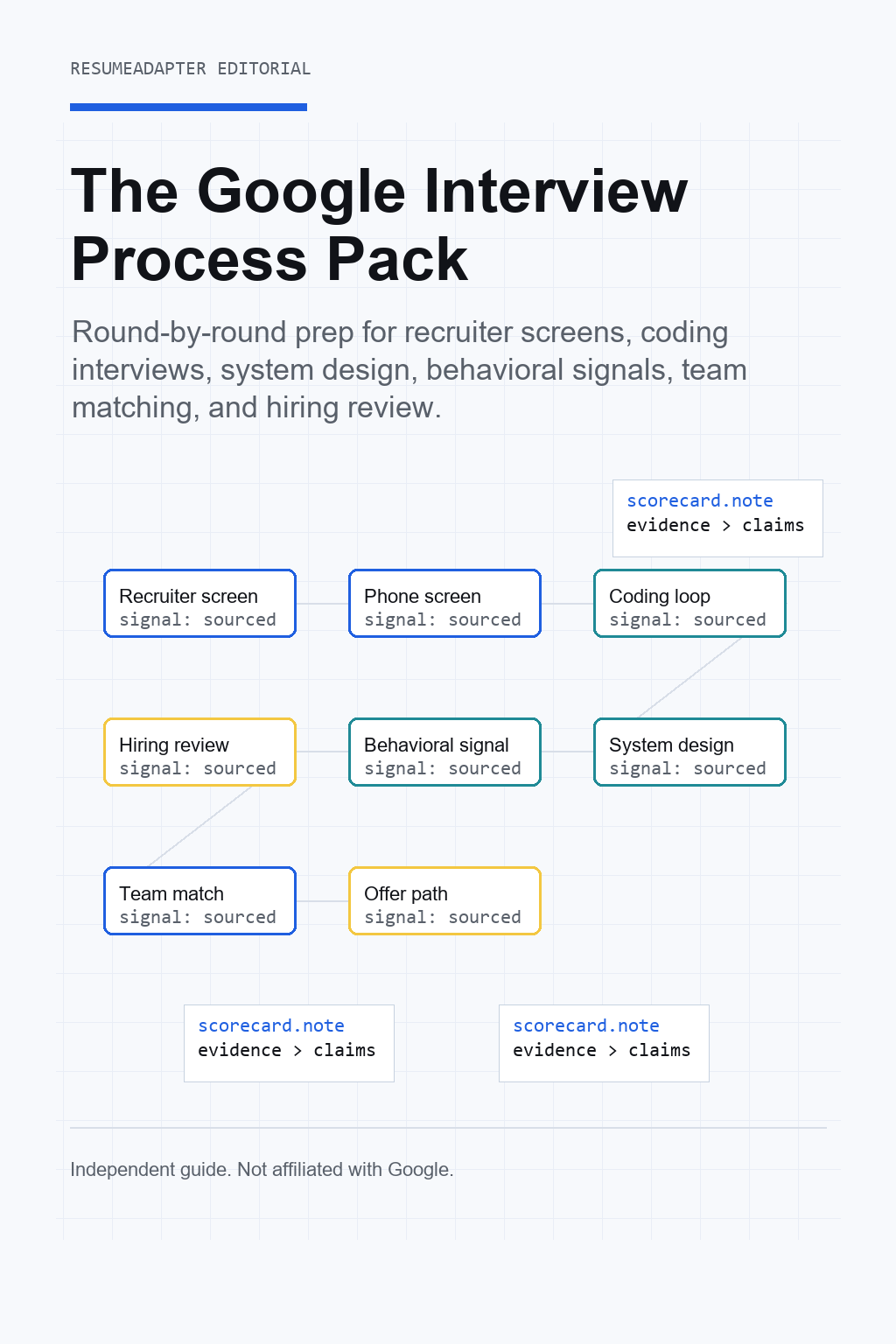
You do not need to name a single attribute on the page. You need four to eight bullets where the attributes are visible in the outcomes themselves, distributed across roles. See the Google levels L3 to L8 spoke for how the bar shifts by band, and the The Google interview process spoke for how the G&L round sits inside the full loop.

FAQ

Googleyness and the four attributes FAQ

The questions candidates surface specifically about Googleyness and the four hiring attributes, after they have read the pillar. Answers are byte-identical to the FAQPage JSON-LD, because AI engines that extract HTML and AI engines that extract JSON-LD should not see different text.

What is Googleyness?

Googleyness is Google's culture-fit hiring signal. As defined by former Google SVP Laszlo Bock in Work Rules! (2015), it covers intellectual humility, comfort with ambiguity, conscientiousness (owners, not employees), enjoying fun, and evidence of courageous or interesting paths. It is commonly summarized as bias to action, collaboration, and user-first thinking.

Did Google change the definition of Googleyness in 2024?

Sort of. On December 18, 2024, CEO Sundar Pichai told staff that Googleyness had become too broad and offered a six-point framing: Mission First, Make Helpful Things, Be Bold & Responsible, Stay Scrappy, Hustle & Have Fun, and Team Google. This is a company-culture and values reframe, not a documented change to how candidates are interviewed or scored for the Googleyness attribute.

What are Google's four hiring attributes?

Google evaluates candidates on four attributes: General Cognitive Ability (solving novel problems and learning), Role-Related Knowledge (the specific expertise for the role), Leadership (emergent, influence without authority), and Googleyness (culture fit). The framework is attributed to Laszlo Bock's Work Rules! and recruiting sources, not a current live Google page.

Which attribute matters most?

General Cognitive Ability is widely reported as the most heavily weighted of the four, because Google bets that a strong learner can acquire role-specific knowledge over time. Role-Related Knowledge is reported as the least weighted, though it is still verified in the interview. This weighting is from Bock and recruiter sources, not an official published matrix.

How do I show Googleyness on a resume without naming it?

Demonstrate it, do not label it. Surface comfort with ambiguity, bias to action, collaboration, and intellectual humility through concrete bullets: navigated undefined requirements to launch X, reprioritized on user feedback, partnered across teams to unblock Y. Naming Googleyness or culture fit as a buzzword reads as telling rather than showing, and lone-hero framing reads as un-Googley.

Is Googleyness scored separately from Leadership?

Often not in practice. Google runs a dedicated behavioral interview commonly called Googleyness & Leadership (G&L), typically one round of about 45 minutes with roughly four to six behavioral questions answered in STAR format. Interviewers frequently merge the Googleyness and Leadership signals into one combined question set rather than scoring them in isolation.

Engineer your Google resume

Run your resume against
a Google job description.

Get your match score against the Google Careers posting, the attributes that read as buzzwords instead of demonstrated outcomes, the Role-Related Knowledge depth that is thin, and a rewrite plan that surfaces all four attributes in the bullets themselves. Free to scan; no signup to see the score.

Your resume stays yoursAnalyzed in seconds, then deleted. Never stored. Never used to train AI.Google Careers ready