ResumeAdapter
Updated 2026-06-27

The PwC Professional has two dimensions.
The five you have read are legacy.

Why this matters

PwC presents The PwC Professional in two dimensions: Trusted Leadership and Distinctive Outcomes. Most prep still shows five attributes; those are the legacy model. This page names the two current dimensions verbatim from PwC, reconciles the old five, then goes where the careers site does not: it maps each behavior to the resume and interview evidence that actually proves it.

Scan my PwC resumeFree to scanTwo current dimensionsResume evidence mapped
By the numbers
PwC's current model
2
Dimensions of The PwC Professional
The dimensions
Trusted + Distinctive
Trusted Leadership, Distinctive Outcomes
The legacy model
Five attributes
Now consolidated into the two
Source
pwc.com
The PwC Professional page
The two dimensions, in one definition each

The PwC Professional's two dimensions.

The dimension names and the definitions below are PwC's own, as published on The PwC Professional page and the firm's talent site. The current count is two, not the five attributes still common in third-party prep, which we reconcile further down.

01
Trusted Leadership. A set of behaviors that prioritize the way we achieve outcomes. These behaviors enable us to deliver for ourselves, our clients and the communities in which we serve.
02
Distinctive Outcomes. A set of behaviors that enables us to bring our collective expertise, collaboration and inclusiveness to our stakeholders. These behaviors are rooted in our commitment to excellence and are a result of challenging old assumptions and taking on new opportunities.

Dimension names and definitions from PwC's The PwC Professional page, pwc.com/us/en/careers/why-pwc/pwc-professional.html, and jobs-ta.pwc.com/global/en/the-pwc-professional (accessed 2026-06-27).

The quick answer

How do you show The PwC Professional on a resume?

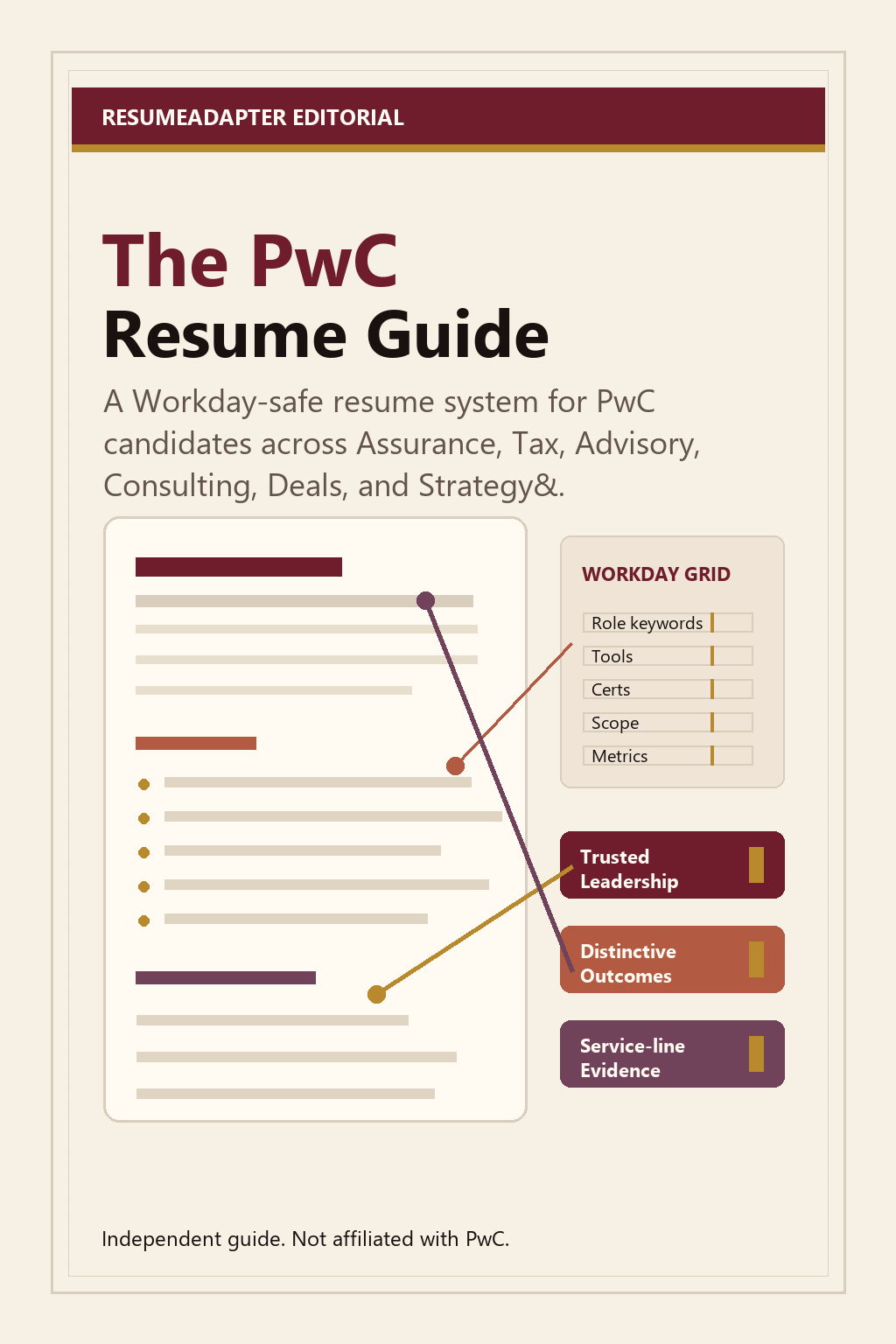
PwC presents The PwC Professional in two current dimensions: Trusted Leadership, the behaviors behind how you achieve outcomes, and Distinctive Outcomes, the commitment to quality, a business mindset, and collaboration. The older five attributes, Whole Leadership, Business Acumen, Technical Capabilities, Global Acumen, and Relationships, are the legacy model, now consolidated into the two. It is a development framework PwC says it recruits and manages against, not a numbered scorecard, so the move is to prove each dimension through a concrete, quantified outcome rather than naming it. For Trusted Leadership, show a relationship you grew, someone you coached, or a change you drove first. For Distinctive Outcomes, show a quality or integrity call you owned, a result in commercial terms, and a client outcome delivered through a team. Do not build a labeled section, and never write that you have integrity; let the behavior show in the work. The dimension names are PwC's; the resume mapping is ResumeAdapter editorial guidance. Scan your resume to see which signals a recruiter would actually find. Scan your PwC resume.

PwC presents The PwC Professional, its global development and leadership framework, in two dimensions: Trusted Leadership, a set of behaviors that prioritize the way outcomes are achieved, and Distinctive Outcomes, a set of behaviors rooted in a commitment to excellence. PwC says it recruits, develops, and manages its people against the framework, and publishes a short set of self-assessment prompts under each dimension. It is presented as the standard the firm develops against, not as a numbered interview scorecard.

The PwC Professional is the firm's global development and leadership framework, the standard PwC says it recruits, develops, and manages everyone against. Its current model has two dimensions: Trusted Leadership and Distinctive Outcomes. This page names them verbatim from PwC, along with the self-assessment prompts the firm publishes under each.

One currency note up front, because it is where most prep is wrong: PwC's current framework has two dimensions, not the five attributes you will still find across third-party guides. We reconcile that five-to-two history in its own section, so you can stop mapping your resume to a model PwC has moved on from.

One honest caveat too: The PwC Professional is a development framework, and interviews are widely reported to assess against it, but PwC does not publish a numbered candidate scorecard that grades each interview answer. So anyone telling you to map exactly six stories and expect to be marked on each is describing a useful prep habit, not PwC's stated process. We flag that distinction throughout. Note also that The PwC Professional is separate from PwC's five values, the culture statement; the FAQ below keeps the two apart.

The reading is the same for every behavior: a reviewer indexes on the dimension being visible in the bullet itself, not asserted as an adjective. A line that reads trusted, collaborative professional, passionate about quality fails, because it names the dimensions. A line that reads cut a client's close time 30 percent by teaming tax and technology specialists across two regions passes, because it shows Distinctive Outcomes without ever using the phrase. The six signals below give you that pattern for both dimensions.

The six signals, under two dimensions

Each behavior, what it means,
and the evidence that proves it.

PwC publishes three self-assessment prompts under each dimension. Those six prompts are the signals below, grouped by their parent dimension. The dimension names and the quoted prompt under each are PwC's; the intent and the resume mapping are ResumeAdapter editorial guidance, not a PwC claim.

Dimension 01

Trusted Leadership

A set of behaviors that prioritize the way we achieve outcomes. These behaviors enable us to deliver for ourselves, our clients and the communities in which we serve.

01
Signal 01

Understand your impact on others

PwC's self-assessment prompt

Do you understand your impact on others and how this influences whether people want to work with you?

How PwC reads it (editorial)

PwC frames Trusted Leadership around how you achieve outcomes, and the first prompt is about self-awareness: whether you read your effect on the people around you well enough that they want you on the work. On a client-service firm, that reads as trust earned, not authority claimed.

How to show it (ResumeAdapter editorial)

ResumeAdapter editorial guidance: show a relationship or reputation you built and what it unlocked. Point to a client you kept and grew, a stakeholder group you aligned, or a team that asked for you again, each with the result. Impact on others is evidence a reviewer can read, never a line that calls you personable.

Show this on the resume

Show the trust you earned and the outcome it produced: a renewed account, a stakeholder you turned around, a team that requested you. Name the effect, not the trait.

Rebuilt a strained client relationship on a stalled engagement, earning a renewal and a 22 percent account expansion the following year.

Avoid this anti-pattern

Adjective-only self-description. Strong interpersonal skills and a team player names the behavior PwC reads for instead of proving you acted on it.

Personable team player with strong interpersonal and communication skills.

Interview prep

Story to prepare: a time your read on a client or teammate changed how the work went, what you did, and the result. Tell it as a specific moment, not a self-assessment.

02
Signal 02

Coach and work side by side

PwC's self-assessment prompt

Do you coach and work side by side with others?

How PwC reads it (editorial)

PwC reads coaching as core leadership, not a side activity: the people who develop colleagues and team alongside them, rather than direct from a distance. On long engagements staffed across levels, that is how delivery holds together.

How to show it (ResumeAdapter editorial)

ResumeAdapter editorial guidance: show who you developed and the effect on the work. Point to associates you coached toward promotion, an onboarding change that cut ramp time, or a junior you brought along, each with a concrete result. Coaching shown is coaching that moved an outcome.

Show this on the resume

Show the people and the result: someone you coached, a capability you built into the team, a ramp you shortened. Name the effect, not the intention.

Coached two associates to promotion while running an engagement, cutting their ramp time from six weeks to three with a reusable playbook.

Avoid this anti-pattern

Span-of-control phrasing with no development shown. Managed a team of six describes a headcount, not the coaching PwC reads this prompt for.

Managed a team of six and oversaw their day-to-day deliverables.

Interview prep

Story to prepare: a colleague you coached side by side, what you did, and how it changed the outcome for them and the engagement.

03
Signal 03

Keep growing, with an eye to the future

PwC's self-assessment prompt

Do you continuously find ways to grow as a professional, actively seeking opportunities to learn with an eye towards the future?

How PwC reads it (editorial)

On a firm reinventing audit, tax, and advisory around AI in 2026, this prompt points to people who upskill and lead change rather than wait for it. PwC reads it as initiative and forward motion, not credential collecting.

How to show it (ResumeAdapter editorial)

ResumeAdapter editorial guidance: show a capability you built or a change you drove first. Point to a tool or method you introduced, a skill you brought to the team, or an initiative others adopted, with the result it produced. Growth is an action you took, never a trait you claim.

Show this on the resume

Make yourself the one who moved things forward, and name what changed because of it. Show the initiative and the outcome in the same line.

Taught myself the firm's new analytics tooling, then built a reusable testing model two later teams adopted, cutting their fieldwork rework.

Avoid this anti-pattern

Passive phrasing that hides any initiative. Eager to learn and grow states the value instead of showing a change you drove.

Eager to learn, grow, and take on new challenges as they arise.

Interview prep

Story to prepare: a skill or method you picked up ahead of the team and put to work, what you changed, and the result it produced.

Dimension 02

Distinctive Outcomes

A set of behaviors that enables us to bring our collective expertise, collaboration and inclusiveness to our stakeholders. These behaviors are rooted in our commitment to excellence and are a result of challenging old assumptions and taking on new opportunities.

04
Signal 04

Commit to quality and integrity

PwC's self-assessment prompt

Do you commit to quality, integrity and inclusive behaviors?

How PwC reads it (editorial)

Distinctive Outcomes is rooted in a commitment to excellence, and this prompt is the floor: quality, integrity, and inclusive behavior. For a Big 4 firm working across a client's controls, financials, and confidential data, PwC reads it as judgment under pressure, not a soft value.

How to show it (ResumeAdapter editorial)

ResumeAdapter editorial guidance: show a quality bar you held or a risk you owned. Point to a control you built, an issue you flagged before sign-off, or a hard call you stood behind, with the exposure you reduced. Demonstrate the judgment in the work; a line that calls you ethical is the weakest version.

Show this on the resume

Show a costly, owned action: a risk you raised, a control you tightened, a quality call you made when staying quiet was easier. Let the action carry it.

Flagged a revenue-recognition gap before sign-off and rebuilt the control with automated evidence capture, correcting a 4.2 million dollar misstatement.

Avoid this anti-pattern

Naming integrity as a trait. Highly ethical professional with strong attention to quality states the prompt instead of proving it, and reviewers discount it on sight.

Highly ethical professional with strong attention to detail and quality.

Interview prep

Story to prepare: a quality or integrity call you owned, what was at stake, and why you raised it. A specific moment beats a principle.

05
Signal 05

Apply a business mindset

PwC's self-assessment prompt

Do you apply a business mindset to the work you do and understand the market around us?

How PwC reads it (editorial)

PwC reads this as commercial fluency: whether you frame the work in terms of client value and market context, not internal activity. The screen rewards a candidate who connects what they did to what it was worth.

How to show it (ResumeAdapter editorial)

ResumeAdapter editorial guidance: lead every bullet with the business value created, in commercial terms. Cut a client's monthly close from 12 to 7 days, freeing 200 controller hours reads as a business mindset; supported various client engagements does not.

Show this on the resume

Frame the work as value: revenue influenced, cost or risk removed, time freed, in a number a business reader recognizes. Show the commercial result, not the task.

Identified 1.3 million dollars in annual vendor-spend savings during a client finance review and built the case that won board approval to act on it.

Avoid this anti-pattern

Activity phrasing with no commercial frame. Responsible for various analyses and supporting tasks describes motion, not the value PwC reads for.

Responsible for various analyses and supporting day-to-day client tasks.

Interview prep

Story to prepare: a time you framed your work in commercial terms a client acted on, the market context, and the value it created.

06
Signal 06

Collaborate for distinctive client experiences

PwC's self-assessment prompt

Do you collaborate with others to deliver quality and distinctive client experiences?

How PwC reads it (editorial)

PwC delivers through teams that cross competencies, geographies, and specialisms, so this prompt rewards orchestrated, measurable results over solo output. It points to people who pull the right collaborators together and can name the impact.

How to show it (ResumeAdapter editorial)

ResumeAdapter editorial guidance: show the collaboration and the number it moved. Point to a cross-team or cross-border delivery you coordinated, specialists you brought in, or a multi-function effort you ran, and quantify the client impact. Replace single-handedly with the team that produced the outcome.

Show this on the resume

Show the collaboration you led and the measurable client result it produced: teams you connected, a cross-border scope, a number you can attribute to the joint effort.

Coordinated tax, assurance, and technology specialists across two regions on a client transformation, delivering a reporting redesign that cut close time 30 percent.

Avoid this anti-pattern

Solo-hero phrasing that erases the team. Single-handedly delivered reads against a prompt built on collaboration, and reviewers distrust it on a teaming firm.

Single-handedly delivered the entire engagement with no input from other teams.

Interview prep

Story to prepare: a distinctive client result that only happened because you teamed across functions or borders, who you pulled in, and the measurable impact.

Dimension names and quoted prompts from PwC's The PwC Professional page and talent site. The intent and the resume and interview mapping are ResumeAdapter editorial guidance, not a PwC claim.

If you came for the five attributes

The legacy five, reconciled to the two.

If you have seen the older five attributes, still all over third-party prep, here is the reconciliation. PwC refreshed The PwC Professional into the two dimensions above. The behaviors did not vanish; they consolidated. Whole Leadership and Relationships map into Trusted Leadership; Business Acumen, Technical Capabilities, and Global Acumen map into Distinctive Outcomes. Map your resume to the two current dimensions, not the five.

Whole LeadershipMaps into Trusted Leadership
Leading yourself, others, and the business now lives in the behaviors behind how you achieve outcomes.
RelationshipsMaps into Trusted Leadership
Building trust and working side by side with clients and teams is the heart of Trusted Leadership.
Business AcumenMaps into Distinctive Outcomes
Applying a business mindset and reading the market is one of the three Distinctive Outcomes prompts.
Technical CapabilitiesMaps into Distinctive Outcomes
Quality, integrity, and deep expertise sit under the commitment to excellence in Distinctive Outcomes.
Global AcumenMaps into Distinctive Outcomes
Working across borders and cultures folds into delivering distinctive client experiences through collaboration.

The five attributes are the legacy model. The mapping to the two current dimensions is ResumeAdapter editorial reconciliation. We do not state the exact date of the change, because PwC has not published one.

Some candidates arrive expecting a PwC version of Amazon's leadership principles: a list the interview is explicitly scored against, behavior by behavior. PwC does not publish one. What it publishes is The PwC Professional, the framework it says it recruits, develops, and manages against, with self-assessment prompts under two dimensions, not a numbered candidate scorecard that grades each interview answer.

The practical difference for you is small. Whether a firm uses a scored rubric or a development framework, the winning resume move is identical: prove the behavior through a quantified outcome rather than naming it. Do not build a labeled The PwC Professional section on your resume; build bullets where the two dimensions are visible in the results. And in the interview, bring specific stories with a real stake and a measurable outcome, which work whether or not a question is tagged to a dimension.

Interview questions by dimension

Questions that probe the dimensions.
Preparation, not a PwC question bank.

PwC interviews are widely reported to include behavioral questions that map to The PwC Professional, the dimensions of trusted leadership and distinctive outcomes. The questions below are ResumeAdapter preparation guidance, worded to help you rehearse against each dimension. PwC does not publish an official question tied to each prompt, so treat these as a way to prepare, not as the firm's stated questions or a scorecard.

01
Probes: Trusted Leadership

Tell me about a time your relationship with a client or teammate changed the outcome of the work.

A question of this shape tends to probe self-awareness and the trust you earn. Prepare a specific moment where your read on someone moved the result, not a statement that you are a people person.

02
Probes: Trusted Leadership

Describe a time you coached someone, especially while doing the work alongside them.

This tends to probe whether you develop people while you deliver. The strongest answers name a person you coached and a concrete outcome, rather than a span of control.

03
Probes: Distinctive Outcomes

Tell me about a hard quality or integrity call you had to make when staying quiet would have been easier.

This tends to probe judgment under pressure and whether you own the outcome. Bring a specific moment with a real stake, not a principle about doing the right thing.

04
Probes: Distinctive Outcomes

Walk me through a time you framed your work in commercial terms a client acted on.

This tends to probe a business mindset. Have the market context and the value created ready, in a number a business reader recognizes.

05
Probes: Distinctive Outcomes

Give an example of a distinctive client result you could not have delivered alone. Who did you bring in, and what was the impact?

This tends to probe collaboration and whether you can attribute a measurable result to it. Have the named collaborators and the number ready.

These questions are ResumeAdapter preparation guidance built around The PwC Professional's two dimensions, not PwC-issued questions or a scored rubric.

How to show The PwC Professional

Five moves from
generic resume to PwC-true.

01
Step 01

Lead with a trusted relationship you built

Trusted Leadership opens on your impact on others and on coaching. Make yourself the one who earned trust and developed people: a client you kept and grew, an associate you coached toward promotion, with the measurable result. Replace personable with the relationship outcome you actually produced.

02
Step 02

Show that you keep growing and lead change

Trusted Leadership also asks whether you grow with an eye to the future. Point to a tool or method you introduced first, a skill you brought to the team, or an initiative others adopted, with the result. Initiative is an action you took, never a trait you claim.

03
Step 03

Prove quality and integrity with an owned action

Distinctive Outcomes starts with a commitment to quality, integrity, and inclusive behavior. Point to a control you built, a risk you flagged before sign-off, or a hard call you owned, with the exposure you reduced. Never write that you are ethical; show the action and let it carry the value.

04
Step 04

Quantify a distinctive client outcome delivered as a team

Distinctive Outcomes also rewards a business mindset and collaboration. Lead every bullet with a client result framed in commercial terms and the team that produced it. Cut a client's monthly close from 12 to 7 days, freeing 200 controller hours reads as a distinctive outcome; supported various engagements does not.

05
Step 05

Scan and iterate against a PwC posting

Upload to ResumeAdapter against a specific PwC posting to see where your bullets name the dimensions as adjectives instead of demonstrating them, and iterate until trusted relationships, initiative, quality, a business mindset, and measurable collaboration are visible in the work.

FAQ

The PwC Professional, FAQ

The questions candidates surface about what PwC actually develops and screens for, after they have read the pillar. Answers are byte-identical to the FAQPage JSON-LD, because AI engines that extract HTML and AI engines that extract JSON-LD should not see different text.

What is The PwC Professional?

The PwC Professional is PwC's global development and leadership framework, the standard the firm says it recruits, develops, and manages everyone against. Its current model has two dimensions: Trusted Leadership, the behaviors behind how you achieve outcomes, and Distinctive Outcomes, the commitment to quality, a business mindset, and collaboration that delivers for clients. PwC publishes the two dimensions and a short set of self-assessment prompts under each, on pwc.com and its talent site. One honest caveat: it is a development framework, and interviews are widely reported to assess against it, but PwC does not publish a numbered candidate scorecard that grades each interview answer, so treat mapping your stories to the dimensions as useful preparation rather than PwC's scored process. The dimension names and definitions are PwC's; the resume mapping on this page is ResumeAdapter editorial guidance.

What are the five dimensions of The PwC Professional?

This is the most common question, and the honest answer corrects it: the five are the legacy model, and PwC's current framework has two dimensions, not five. The older five attributes, Whole Leadership, Business Acumen, Technical Capabilities, Global Acumen, and Relationships, still appear across third-party prep, but PwC refreshed The PwC Professional into two dimensions: Trusted Leadership and Distinctive Outcomes. The behaviors did not vanish, they consolidated. Whole Leadership and Relationships map into Trusted Leadership; Business Acumen, Technical Capabilities, and Global Acumen map into Distinctive Outcomes. If a guide tells you to map your resume to five dimensions, it is working from the old model. Map to the two current dimensions instead, and prove each one through a quantified outcome.

How do I show The PwC Professional on my resume?

Prove the behaviors through quantified outcomes, and never name them. Do not build a labeled section; build bullets where the dimension is visible in the result. For Trusted Leadership, show a relationship you grew, someone you coached toward promotion, or a change you drove first, each with the outcome. For Distinctive Outcomes, show a quality or integrity call you owned, a result framed in commercial terms, and a client outcome delivered through a team with a number attached. A line like cut a client's monthly close from 12 to 7 days, freeing 200 controller hours proves a business mindset and a distinctive outcome without naming either. This mapping is ResumeAdapter editorial guidance; the dimension names are PwC's. Scan your resume to see which of these signals a recruiter would actually find.

Is The PwC Professional the same as PwC's values?

No, they are two different things. The PwC Professional is the firm's development and leadership framework, the two dimensions, Trusted Leadership and Distinctive Outcomes, that PwC recruits and manages against. PwC's values are a separate statement of culture: Act with integrity, Make a difference, Care, Work together, and Reimagine the possible. The values describe how PwC people are expected to behave; The PwC Professional describes the capabilities the firm develops and assesses. They overlap in spirit, for example integrity appears in both, but they are not the same list, and a resume should prove The PwC Professional's two dimensions through outcomes rather than reciting either set.

Engineer your PwC resume

Run your resume against
a PwC job description.

Get your match score against the PwC posting, the dimensions your bullets state as adjectives instead of demonstrating, the generic phrasing that hides your client and team impact, and a rewrite plan. Free to scan; no signup to see the score.

Your resume stays yoursAnalyzed in seconds, then deleted. Never stored. Never used to train AI.PwC job description scored