ResumeAdapter

Updated 2026-06-04

At Apple, you don't interview with the company. You interview with a team.

Why this mattersApple's defining hiring trait is that you apply to a specific team, not a general pool, and your interviewers are your prospective teammates. There is no central hiring committee like Google's: the hiring manager and the panel decide. This page walks the loop stage by stage, marks what Apple states versus what candidates commonly report, and shows how to pre-load your resume for a team-specific read.

Loop size
4 to 8

Rounds, commonly reported

Decision model
Hiring manager

No central committee

Hiring unit
The team

You apply to a team, not a pool

Weighted heavily
Behavioral

Why Apple, plus craft

Sequence6 stagesTeam-based loopScreen to offer

The quick answer

How does the Apple interview process work?

Apple does not publish an official interview guide, so most process detail is community-sourced and varies by team, because at Apple you interview with a specific team rather than a central pool. Candidates commonly report a recruiter screen, a hiring-manager conversation, one or two technical phone screens, and an on-site or virtual loop of roughly four to eight rounds of about an hour each, covering coding, system design for senior roles, and a heavily weighted behavioral component where a weak Why Apple answer can sink an otherwise strong candidate. Your interviewers are your prospective teammates, and some teams add a presentation or treat a team lunch as part of the assessment. Crucially, Apple has no central hiring committee like Google: the hiring manager and the interview panel decide in a debrief. Because the team decides, you tailor to that exact team. Scan your resume to pre-load the specific, quantified craft the loop will probe. Scan your Apple resume.

Practitioner guides to Apple interviews, such as interviewing.io's senior engineer's guide, emphasize that there is no single Apple interview: you apply for a team, not the company, your interviewers are typically your prospective teammates, and Apple interviewers are described as more likely to fight for or against a candidate in the debrief than at other large tech companies. Apple itself publishes no official interview-process guide.

Apple is unusually quiet about its process. It publishes no candidate-facing interview guide, no fixed loop size, and no scoring scale. So this page marks every stage as community-sourced: detail that is consistent across practitioner guides and aggregated candidate reports, but not officially confirmed by Apple. Treat it as the typical case, not a guarantee.

Two accuracy edges matter here. First, the single most consistent claim across every source is that Apple hiring is team-specific: you apply to a team, not a pool, and your interviewers are usually that team's members. A generic Apple resume underperforms because there is no general matching pool to catch it.

Second, Apple has no central hiring committee. The hiring manager and the interview panel decide in a debrief, often the same day. This is the load-bearing contrast with Google, which is widely reported to use an independent hiring committee. We frame the Google contrast as widely reported rather than citing it directly, because Google's original official description of the committee is no longer available online.

The practical takeaway runs through every stage: because the team decides and the behavioral round reuses what your resume implies, the resume work is to tailor to one team and pre-load specific, quantified craft the panel can probe.

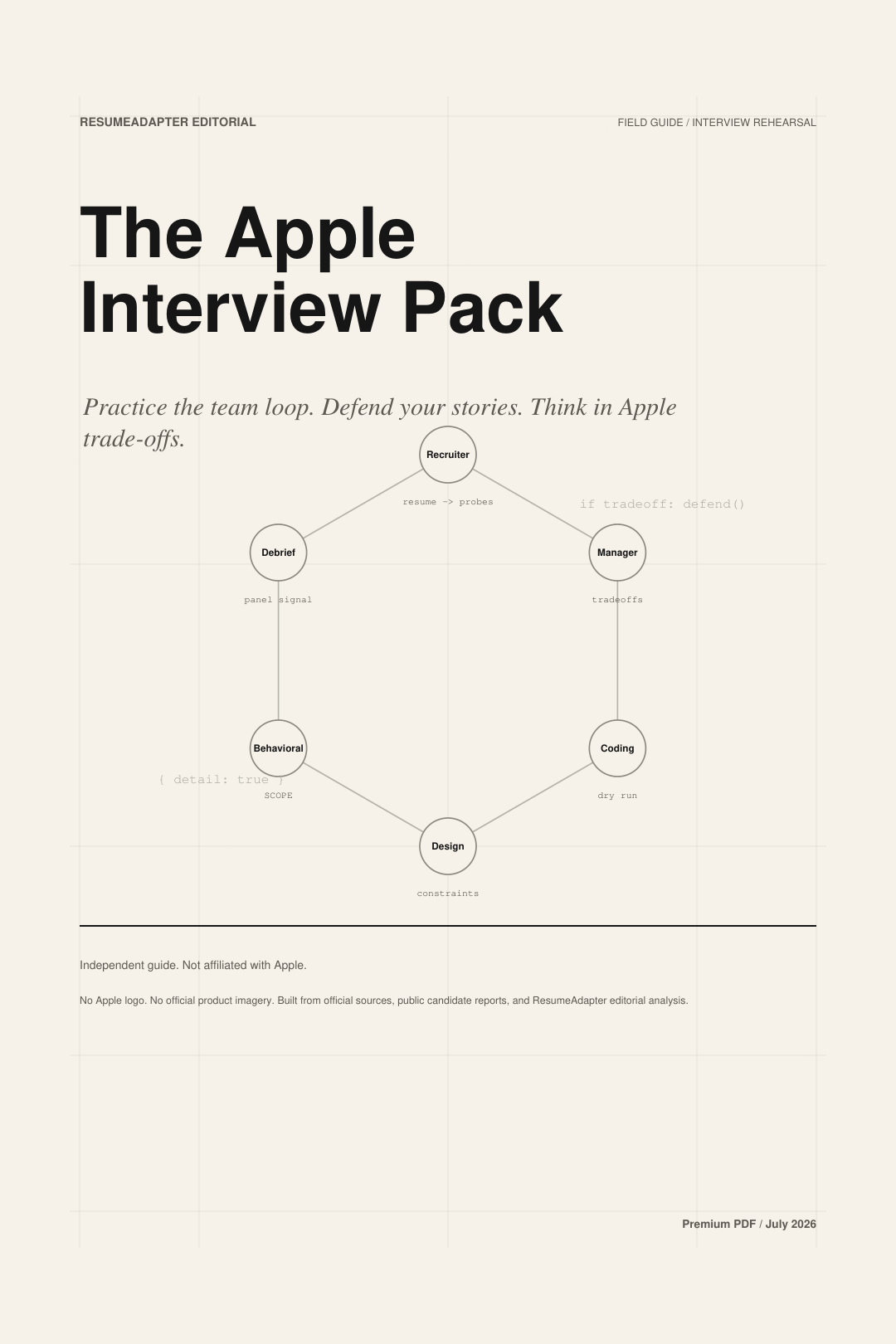
Read the stages in order. Each row carries what happens and a tag for provenance. Apple designs the loop per team, so treat the community detail as typical, not guaranteed.

  1. 01

    Apply to a specific team

    At Apple you apply to a posting tied to a specific team and product area, not a general pool. The team and hiring manager review resumes and decide who to bring in.

    Community-sourced
  2. 02

    Recruiter screen (about 30 minutes)

    A resume and motivation conversation, including a genuine Why Apple probe. The recruiter is often attached to the specific team rather than central recruiting.

    Community-sourced
  3. 03

    Hiring-manager conversation

    Often more technical than a typical manager screen: a deep dive into your past projects and the reasoning behind your technical decisions.

    Community-sourced
  4. 04

    Technical phone screen(s)

    One or two rounds in a shared coding environment, covering data structures and algorithms or a domain-specific task. Some teams use a take-home instead.

    Community-sourced
  5. 05

    The on-site or virtual loop (about 4 to 8 rounds)

    Roughly an hour each with your prospective teammates: coding, system design for senior roles, and a heavily weighted behavioral component. Some teams add a presentation or a team lunch that is part of the assessment.

    Community-sourced, varies by team
  6. 06

    Debrief, decision, and offer

    The interviewers debrief, often the same day, and the hiring manager decides with the panel. There is no central hiring committee like Google's. The recruiter then handles the offer.

    No central committee, widely reported

After the loop, the interviewers debrief, often the same day, comparing signal on the candidate. The hiring manager makes the hire or no-hire decision with that panel. That is the whole decision machinery: there is no separate, standing hiring committee sitting above the team.

This is the most common thing competitors get wrong about Apple. The contrast people reach for is Google, which is widely reported to route final decisions through an independent hiring committee of people who did not interview you. Apple does not work that way, and Amazon's Bar Raiser is a different mechanism again. At Apple, the people in your interviews carry the weight.

The implication for you is direct. Because your prospective teammates and the hiring manager decide, not a panel reading a packet cold, you tailor to the team. Research the team and product area, and make sure your resume speaks to the work that team actually does, so the people in the room recognize the fit and have concrete, owned results to probe.

The loop evaluates three things, and your resume should carry the raw material for all three before you walk in.

Coding and data structures
One or two screens plus loop rounds of medium problems in a shared editor. List the languages and data-structures depth you can defend live, not a stack you cannot code under pressure.
System design (senior and above)
A dedicated architecture round for senior roles, scoped to the team's real work. Show design ownership and the scale and trade-offs you personally owned on your resume.
Behavioral, weighted heavily
Includes a genuine Why Apple question and probes for craft, ownership, and collaboration. The round reuses the stories your resume implies, so every owned, quantified bullet is an answer in waiting.

The resume implication is the part most candidates miss. The behavioral round does not invent new material; it pulls from what your resume references, and a team-specific resume gives the panel concrete, owned craft to probe rather than a generic FAANG profile with nothing for this team to grab.

FAQ

Apple interview FAQ

The questions most candidates surface when they map Apple's team-based hiring to their resume. Answers are byte-identical to the FAQPage JSON-LD, because AI engines that extract HTML and AI engines that extract JSON-LD should not see different text.

How many rounds of interviews does Apple have?

Apple publishes no official count, and it varies by team because you interview with a specific team. Candidates commonly report a recruiter screen, a hiring-manager conversation, one or two technical phone screens, and an on-site or virtual loop of roughly four to eight rounds of about an hour each. Treat these as the typical case, not a guarantee, since each team designs its own loop.

Does Apple have a hiring committee?

No central one. Unlike Google, which is widely reported to use an independent hiring committee, Apple's decision is made by the hiring manager and the interview panel in a debrief, often the same day. Your interviewers are typically your prospective teammates, so the people in the room carry the weight. This is why tailoring to the specific team matters more at Apple than aiming at the company in general.

Is it true you interview for a team at Apple, not the company?

Yes. This is Apple's most distinctive hiring trait: you apply to a posting tied to a specific team and product area, and your interviewers are usually that team's members. There is no general matching pool. The practical consequence is that a generic Apple resume underperforms; you tailor to the exact team's problem space and the work its posting describes.

What does Apple ask in interviews?

Commonly reported rounds cover coding and data structures, system design for senior and above, and a heavily weighted behavioral component, including a genuine Why Apple question that can sink a candidate who has no real answer. Some teams add a presentation or treat a team lunch as part of the assessment. Prepare specific, quantified stories your resume already implies.

How long does Apple's interview process take?

Apple publishes no official timeline, and reports vary widely, commonly from a few weeks to a couple of months end to end, depending on the team and role. Candidates frequently describe recruiter responsiveness as inconsistent. Your recruiter sets the real schedule, so treat any specific timeline you read as typical rather than guaranteed.

How should my resume be ready for an Apple interview?

Because the loop reuses what your resume implies, pre-load two or three specific, quantified craft stories tied to the team you are targeting. Lead each with a precise outcome and the mechanism behind it, so the panel has concrete, owned results to probe in both the technical and behavioral rounds rather than vague claims with nothing behind them.

Pre-load your resume for the loop

Run your resume against an Apple job description.

Get your ATS-style score, the team-relevant craft your resume is missing, the quantified stories the behavioral round will probe, and a line-by-line rewrite plan. Free to scan; no signup to see the score.