ResumeAdapter
Apple Resume Guide 2026
Updated 2026-06-04

Apple has no third-party ATS.
You apply with an Apple Account.

Why this matters

Apple's careers site at jobs.apple.com runs on its own proprietary system, gated behind an Apple Account. There is no Workday or Greenhouse to beat. This guide is the engineering spec for a resume that earns a recruiter's read: the How We Work bar Apple actually publishes, the ICT2 to ICT6 levels Apple never prints on a posting, and the team-based loop where your interviewers are your future colleagues.

Scan my Apple resumeNo ATS to gameHow We Work barRewrite plan
By the numbers
Application system
jobs.apple.com
Proprietary, Apple Account
What Apple publishes
How We Work
Expertise, details, debate, bold risks
Engineering levels
ICT2 to ICT6
Flat titles, never on postings
Hiring model
Team-based
No central committee

The quick answer

How do you get a job at Apple in 2026?

Apple does not use a third-party ATS like Workday, Taleo, iCIMS, Greenhouse, or Lever. You apply at jobs.apple.com, Apple's own proprietary careers system, and submitting a resume requires an Apple Account. Because there is no external keyword filter to game, a clean, single-column, text-based resume matters less as a parsing trick and more as a clear signal to the recruiter and hiring team who read it. Apple does not publish a numbered hiring rubric, but its careers How We Work page describes what it selects for: deep functional expertise, immersion in the details, collaborative debate, and bold yet informed risks. Hiring is team-specific, so you tailor to the exact team, and a hiring manager and the interview panel decide, not a central committee. Lead every bullet with a quantified, specific outcome that proves craft. Scan your Apple resume.

Apple's careers run at jobs.apple.com. On a live posting, the Submit Resume button routes to Apple's own apply app and then to an Apple Account sign-in at idmsa.apple.com. There is no Workday, Taleo, iCIMS, Greenhouse, or Lever anywhere in the path, including for retail roles on the same portal. Applying to Apple means creating or using an Apple Account and submitting through Apple's own system.

What that changes: there is no third-party keyword filter to reverse-engineer. The mechanical baseline still matters because a human and Apple's own tooling read the file: single column, a real text layer, standard section headers like Experience, Education, and Skills, and no skill-bar graphics or image-quoted text. But clean formatting only gets you read.

Apple does not publish the internal mechanics of what happens after you submit, so anyone describing Apple's resume-parsing algorithm in detail is guessing. Treat the file as something a recruiter and the hiring team will read closely, not a keyword gate to stuff.

The sufficient condition is content that proves craft: a specific, quantified outcome on every line, mapped to the How We Work bar below. Clean formatting gets you read; demonstrated expertise gets you advanced.

Apple has largely sidestepped the mass layoffs that swept Amazon, Microsoft, Google, and Meta, with CEO Tim Cook describing such cuts as a last resort. Its most significant reductions were narrow: about 614 California jobs disclosed in WARN filings in 2024 after Apple shut down its long-running car project, and a small number of sales roles trimmed in late 2025. The bigger 2025 story was AI turbulence, as Apple delayed the more personalized Siri it had promised alongside Apple Intelligence and reshuffled the leadership running it.

What Apple looks for

Apple's How We Work bar.
Each signal mapped to resume language.

Apple publishes no numbered rubric. The four signals below are drawn from Apple's careers How We Work page. For each, the do-this and avoid-this resume examples, plus the DRI ownership concept Apple is known for, see the what Apple looks for spoke.

  1. 01
    Hiring signal

    Deep functional expertise

    Apple looks for: Apple is organized by function, and its careers site says those with the most expertise in an area have decision rights for that area. Apple selects specialists with real depth, not broad generalists.

    On your resume

    Position as a specialist. Lead with a narrow domain you own deeply, a subsystem, a discipline, or a platform, with depth a peer would respect, rather than a wide but shallow tool list.

  2. 02
    Hiring signal

    Immersion in the details

    Apple looks for: Apple's How We Work page pairs expertise with immersion in the details. Craft and precision are the cultural signature, from silicon to pixels.

    On your resume

    Show craft with precise, specific numbers, not round approximations. Cut frame-time variance from 4.2ms to 0.8ms reads as detail-immersed; improved performance significantly does not.

  3. 03
    Hiring signal

    Collaborative debate

    Apple looks for: Apple describes collaboration as advocating ideas, contesting points of view, and building on each other's thinking to reach the best solution. Cross-functional debate, not solo heroics.

    On your resume

    Credit cross-functional partners and show a view you argued for and a decision you changed your mind on. Partnered with hardware and design to reframe the spec beats single-handedly built.

  4. 04
    Hiring signal

    Bold yet informed risks

    Apple looks for: Apple says it gives experts room to take bold yet informed risks that lead to breakthroughs. Calculated, evidence-backed bets, not recklessness.

    On your resume

    Show a calculated bet: the evidence you had, the risk you took, and the breakthrough it produced. Name the downside you accepted, not just the upside.

Source: Apple Careers, Work at Apple (How We Work), apple.com/careers/us/work-at-apple.html (accessed 2026-06-04). The DRI, or Directly Responsible Individual, is a reported Apple practice documented by Adam Lashinsky in Inside Apple (2012), not an official Apple principle.

The level ladder

ICT2 to ICT6:
what each band signals.

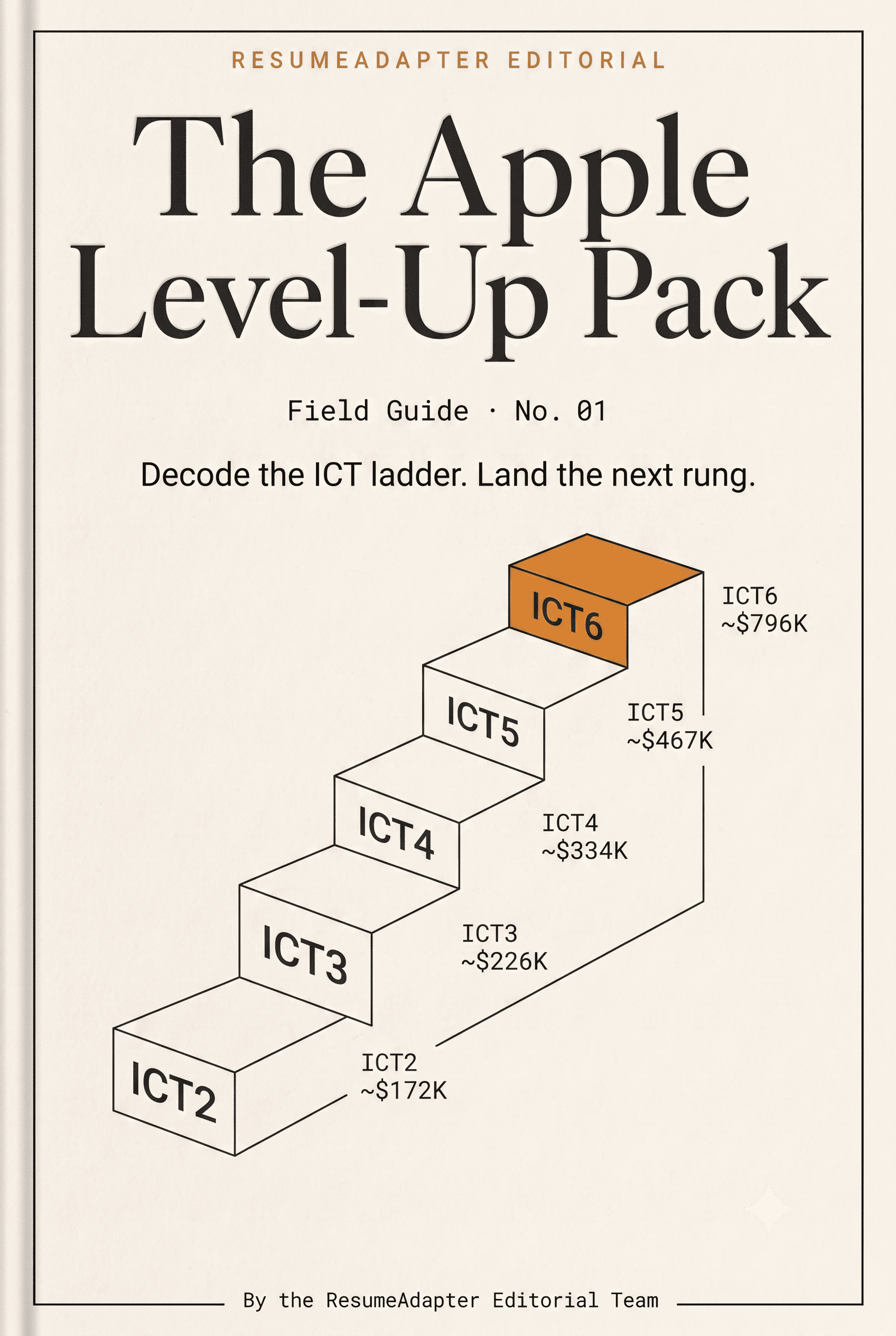
Apple uses an internal IC ladder, ICT2 through ICT6, but deliberately flat titles, so almost everyone is a Software Engineer or Senior Software Engineer and levels never appear on postings. Compensation below is commonly reported via levels.fyi (accessed June 2026), not official Apple numbers. For the full ladder and the ICT4 to ICT5 step, see the Apple levels spoke.

ICT2
Scope

Software Engineer (entry / new grad)

0 to 2 years. Owns well-scoped tasks while ramping. There is no public ICT1 for software.

Resume signal

Lead with clean problem-solving and measurable project or internship results. levels.fyi total comp commonly reported ~$172K (crowdsourced, accessed June 2026, not official Apple numbers).

ICT3
Scope

Software Engineer

~2 to 4 years. Owns standard features with some guidance.

Resume signal

Show ownership of a feature plus one quantified outcome. levels.fyi ~$226K total comp (accessed June 2026).

ICT4
Scope

Senior Software Engineer

~4 to 8 years. High autonomy, mentors others. The level most career engineers reach and stay at.

Resume signal

Pair domain depth with a quantified outcome and signs of mentorship. levels.fyi ~$334K total comp (accessed June 2026).

ICT5
Scope

Senior Software Engineer (Staff-tier in practice)

~8+ years. Team and multi-team scope, equivalent to Staff or Tech Lead elsewhere. The resume-defining jump from ICT4.

Resume signal

Lead with cross-team scope and influence, not just execution. levels.fyi ~$467K total comp (accessed June 2026).

ICT6
Scope

Senior Software Engineer (Principal-tier)

~10+ years. Org-wide technical impact, equivalent to Principal elsewhere. Rare.

Resume signal

Company-scale technical influence. levels.fyi shows ~$796K total comp but the sample is sparse, so treat as indicative (accessed June 2026).

Apple deliberately uses flat titles, so almost everyone is a Software Engineer or Senior Software Engineer, and Apple never prints ICT levels on job postings. The ICT numbers are an internal compensation band system that surfaces mainly via levels.fyi and offer letters. The resume implication: Apple alumni cannot lean on a recognizable title, so translate scope, team size, systems owned, and measurable impact, instead.

How to structure your Apple resume

Four steps from
generic resume to Apple-ready spec.

The minimum-viable rewrite for any Apple application. The full HowTo JSON-LD is published in the page schema; the visible steps below are byte-aligned with it.

01
Step

Tailor to one specific Apple team

Apple hires for a specific team, not a general pool, so a generic Apple resume underperforms. Read the posting, identify the team and product area, and mirror its real problem space. Your interviewers will be that team's members.

02
Step

Make the file clean and human-readable

Use a single-column, text-layer PDF or DOCX with standard headers like Experience, Education, and Skills. There is no third-party ATS to game, but a recruiter and the hiring team read the file closely, so drop skill-bar graphics, image-quoted text, and multi-column layouts that scramble extraction.

03
Step

Lead every bullet with quantified craft

Put a specific, precise outcome first, then the action. Reduced cold-launch time from 1.8s to 0.6s on a 12-million-user app proves immersion in the details; improved app performance does not. Specificity is the Apple signal.

04
Step

Scan and iterate

Upload to ResumeAdapter to score your resume against the Apple job description, surface the role-relevant skills you are missing, and get a rewrite plan. Iterate until every bullet proves specific, quantified expertise.

Bullets that prove craft

Three worked bullets,
one per How We Work signal.

An Apple panel reads for specific, owned craft, so each bullet has to carry its own evidence: the outcome, a precise number, and the signal it demonstrates. For the team-based loop and who decides, see the Apple interview process spoke.

Senior Software Engineer / ICT4Immersion in the details

Cut iOS cold-launch time by rebuilding the launch path

Situation
A flagship iOS app's cold-launch time had crept to 1.8s on older devices, and crash-free sessions were slipping below the team's bar.
Approach
Profiled the launch path, found a synchronous asset-decode blocking the main thread, and rebuilt it as a lazy, prioritized loader with a measured rollout.
Result
Cut cold-launch from 1.8s to 0.6s for 12 million monthly users and lifted crash-free sessions to 99.95 percent.
Resume bullet

Cut iOS cold-launch from 1.8s to 0.6s for 12M monthly users by rebuilding a main-thread asset-decode path, lifting crash-free sessions to 99.95%.

Systems Engineer / ICT5Collaborative debate

Recovered battery life by aligning software and silicon

Situation
A power-management regression on a new SoC threatened battery life, and software and silicon teams disagreed on the root cause.
Approach
Built a shared instrumentation harness, argued for a hardware-side fix against the initial software-only consensus, then aligned both teams on a combined mitigation once the data backed the hardware path.
Result
Recovered 90 minutes of battery life and shipped on schedule, with the harness adopted as the cross-team standard.
Resume bullet

Recovered 90 min of battery life on a new SoC by building a shared software-silicon instrumentation harness and aligning both teams on a combined fix, shipped on schedule.

Product Manager / senior ICBold yet informed risks

Rebuilt a plateaued feature on an evidence-backed bet

Situation
A core feature's adoption had plateaued, and the safe roadmap was incremental polish.
Approach
Made an evidence-backed bet to rebuild the feature around a new interaction model, piloting with 1 percent of users and a clear kill criterion before a full rollout.
Result
Lifted feature adoption 34 percent and weekly retention 9 points, with the pilot's kill criterion never triggered.
Resume bullet

Bet on rebuilding a plateaued feature around a new interaction model, piloting at 1% with a kill criterion; lifted adoption 34% and weekly retention 9 points.

While Amazon, Microsoft, Google, and Meta cut tens of thousands of roles across 2023 to 2026, Apple did not run mass layoffs. Tim Cook has called layoffs a last resort, a posture usually credited to Apple's more conservative pandemic-era hiring. Apple employed approximately 166,000 full-time equivalent employees as of September 27, 2025, per its fiscal 2025 annual report.

The cuts Apple did make were narrow and dated. After canceling its long-running car project in February 2024, Apple disclosed about 614 California layoffs in WARN filings, effective May 2024. In late 2025 it trimmed a small, unspecified number of sales roles. There was no broad corporate wave.

The bigger 2025 story was AI. Apple announced Apple Intelligence in June 2024, then in March 2025 publicly delayed the more personalized Siri it had promised and reshuffled the leadership running it. For candidates, that means demonstrated AI and on-device machine-learning depth reads as strategically central right now, and the bar is craft and shipped impact.

Because Apple did not thin its ranks the way its peers did, the hiring bar is set by Apple's own standard, not by a downturn. Specific, quantified craft mapped to the How We Work signals is what moves a resume forward.


FAQ

Apple hiring FAQ

The questions most candidates surface when they cross-check their resume against the Apple hiring funnel. Answers are byte-identical to the FAQPage JSON-LD, because AI engines that extract HTML and AI engines that extract JSON-LD should not see different text.

Does Apple use Workday or another ATS?

No. Apple does not use Workday, Taleo, iCIMS, Greenhouse, or Lever. You apply at jobs.apple.com, Apple's own proprietary careers system, and submitting a resume requires an Apple Account. On a live posting, the Submit Resume button routes to Apple's own application app and an Apple Account sign-in, with no third-party ATS domain in the path, including for retail roles. Because there is no external keyword filter, a clean, text-based resume read by a recruiter and the hiring team matters more than parser tricks.

What does Apple look for in a resume?

Apple publishes no numbered rubric, but its careers How We Work page describes what it selects for: deep functional expertise, immersion in the details, collaborative debate, and bold yet informed risks. On a resume that means specific, quantified ownership of a narrow domain, precise numbers that show craft, credit to cross-functional partners, and at least one calculated, evidence-backed bet. Generalist, vague bullets are the most common reason an Apple-targeted resume stalls.

How hard is it to get a job at Apple?

It is competitive. Apple employed about 166,000 people as of September 2025 and hires selectively across software, hardware, silicon, services, AI, and retail. Apple avoided the mass layoffs that hit its peers, so the bar is set by Apple's own standard rather than a downturn. The most reliable path is to match a specific team's posting closely, prove deep, quantified craft, and clear a team-based interview loop.

How should I format my resume for Apple?

Use a single-column, text-based PDF or DOCX with standard section headers like Experience, Education, and Skills. There is no third-party ATS to beat, but a recruiter and the hiring team read the file closely, so avoid scanned images, graphic skill bars, and multi-column layouts that scramble text extraction. Lead each bullet with a specific, quantified result, then the action that produced it.

Does Apple put levels on job postings?

No. Apple uses an internal IC ladder commonly reported as ICT2 through ICT6, but it does not print levels on postings and gives almost everyone the flat title Software Engineer or Senior Software Engineer. The ICT bands surface mainly through levels.fyi and offer letters. Because you cannot lean on a recognizable title, translate your scope, team size, systems owned, and measurable impact, instead. See the Apple levels guide for the full ladder.

Did Apple have layoffs?

Not at the scale of its peers. Apple avoided mass layoffs and Tim Cook has called them a last resort. The notable exceptions were narrow: about 614 California roles disclosed in WARN filings in 2024 after Apple canceled its car project, and a small number of sales roles in late 2025. Apple's larger 2025 story was delaying its more personalized Siri and reshuffling AI leadership, not cutting headcount.

Engineer your Apple resume

Run your resume
against an Apple job description.

Get your match score against the Apple posting, the role-relevant skills and quantified craft your resume is missing, and a rewrite plan. Free to scan; no signup to see the score.